Summary
Enterprise knowledge work is drowning in documents. Internal policies, technical specifications, contracts, regulations, and research are scattered across siloed repositories — and the tools built to search them haven’t kept pace with the scale or complexity of real business questions. nexocode built Recordya to change that. Powered by an agentic RAG architecture, Recordya doesn’t just find relevant documents — it reasons across them, connects to live databases and external regulatory sources, and delivers precise, cited answers that knowledge workers can actually act on.
The Problem
Large organizations generate and accumulate knowledge at a pace that outstrips their ability to use it. A compliance analyst needs to cross-reference a new regulation with five internal policy documents and two database fields — and gets a keyword search that returns 300 results. A procurement manager needs to check whether a supplier meets a technical standard buried in a 200-page specification. A legal team member needs to understand how a clause in one contract relates to precedents in a dozen others.
Classic keyword search fails these users because it matches terms, not intent. Basic semantic search improves recall but still retrieves chunks — it doesn’t synthesize, reason, or answer. Even first-generation RAG systems hit a ceiling: single-step retrieval over flat document collections can’t handle the multi-hop, multi-source reasoning that complex enterprise questions require.
The cost of this gap is real: knowledge workers spend an estimated 20–30% of their time searching for information, and many still can’t find what they need. Decisions get delayed. Errors go undetected. Institutional knowledge stays locked.
The Solution: Recordya
nexocode designed Recordya from the ground up as an agentic AI search platform — one where an AI agent plans and executes a reasoning strategy across multiple sources before producing a final answer. The architecture separates retrieval from reasoning, enabling capabilities no single-step search system can match.

Agentic RAG Architecture
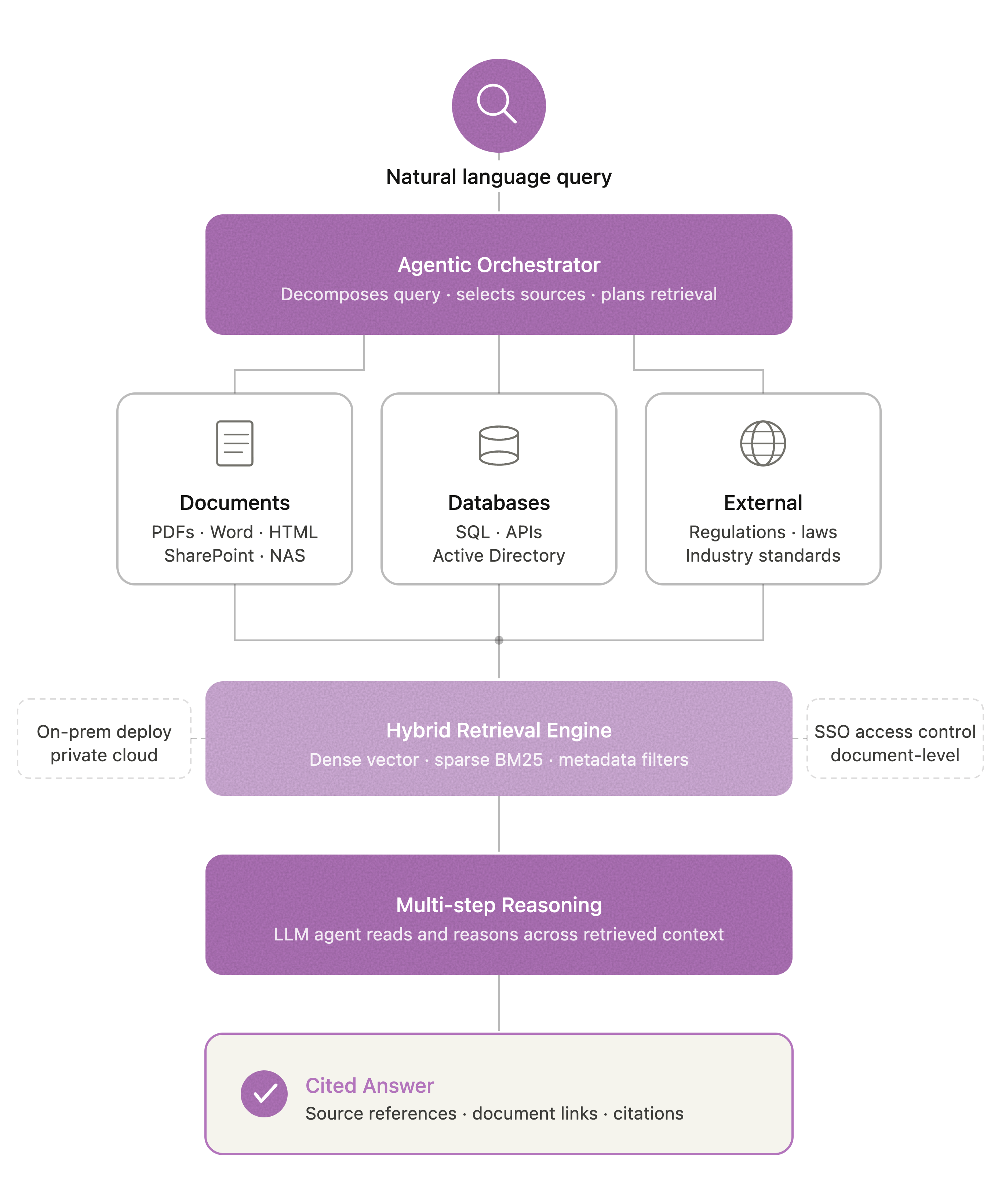
At the core of Recordya is an AI agent that decomposes complex questions into sub-queries, selects the right sources and retrieval strategies for each, synthesizes intermediate findings, and produces a coherent, cited response. Unlike pipeline RAG — where a query goes in and chunks come back — Recordya’s agent decides how to answer, not just what to retrieve.
This enables multi-hop reasoning: the agent can first retrieve a regulatory clause, then use that result to query an internal policy document, then check a database field to verify compliance — all within a single user query.
Multi-Source Connectivity
Recordya is built to reach knowledge wherever it lives:
- Internal document repositories: PDFs, Word documents, presentations, HTML pages, and other unstructured formats are indexed with high-fidelity chunking and metadata preservation.
- Structured databases: Recordya connects directly to relational databases and data warehouses, enabling hybrid queries that combine document reasoning with structured lookups.
- External regulatory and standards sources: Legal regulations, industry standards, and public norms can be ingested and kept current, allowing the system to answer questions that cross the boundary between internal knowledge and external requirements.
Precision Retrieval with Hybrid Search
Recordya combines dense vector search, sparse keyword retrieval, and metadata filtering in a hybrid retrieval layer that is tuned per query type. This avoids the failure modes of purely semantic systems (missing exact terms) and purely keyword systems (missing conceptual matches), delivering higher precision and recall across diverse document types and query styles.
Cited, Auditable Answers
Every answer Recordya produces is traceable. The system surfaces source citations with document references, page numbers, and relevant excerpts, so users can verify responses and build trust in the output. In regulated industries — legal, compliance, finance, pharma — this auditability is not a nice-to-have; it is a requirement.

Dynamic, Context-Aware Widget Library
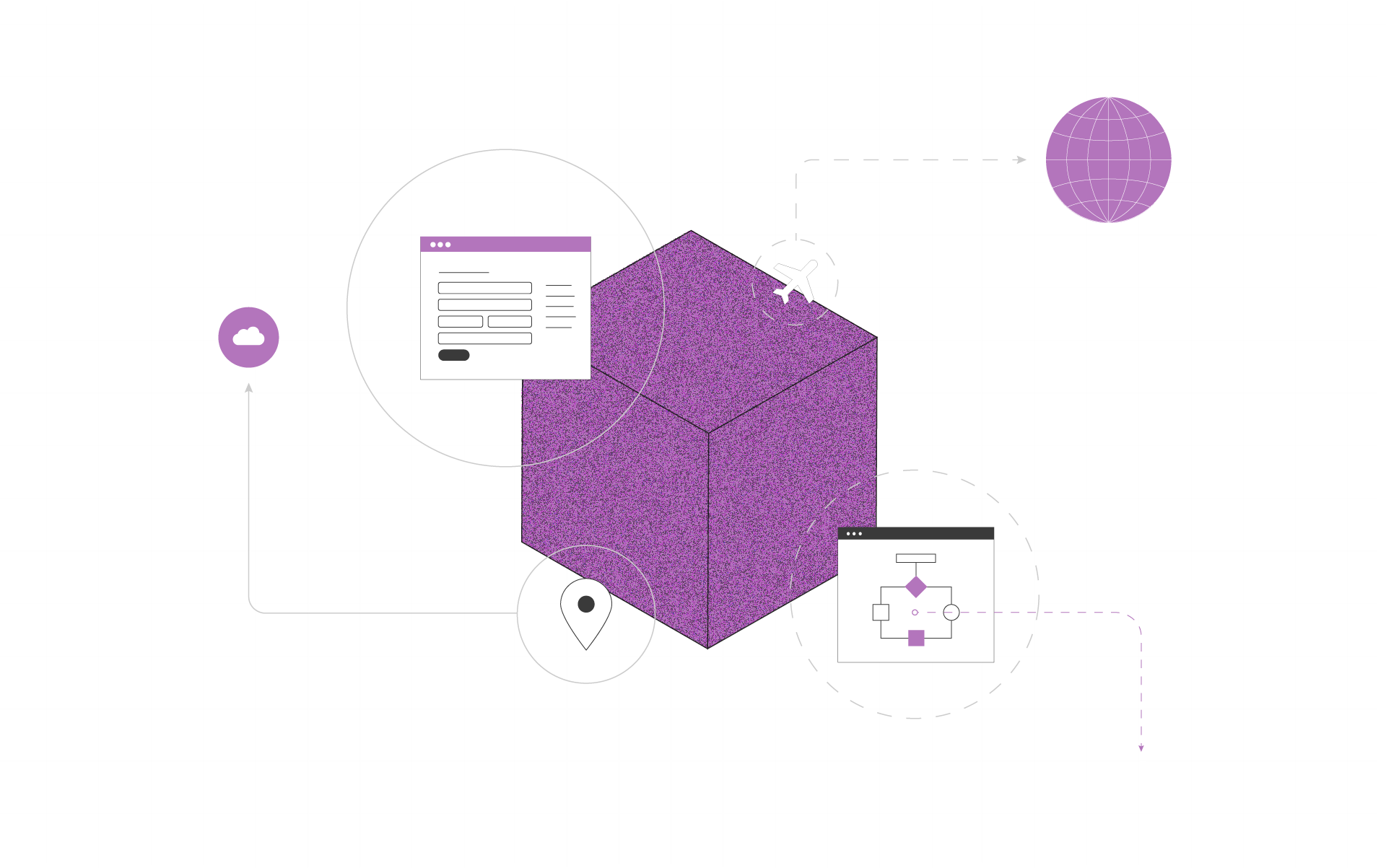
Recordya’s interface goes beyond plain text. When the agent synthesizes a response, it also determines the most appropriate presentation format for the result — and renders it as an interactive widget inline in the conversation.
A question about supplier compliance doesn’t return a paragraph — it renders a structured checklist. A query comparing two products returns a side-by-side comparison table. A question about project timelines returns an interactive timeline view. A data query from a connected database returns a formatted, filterable data grid. The answer arrives in the form that is most immediately useful, not the form that was easiest to generate.

This widget layer is built as an extensible, registerable library. Recordya ships with a core set of pre-built widget types: comparison tables, data grids, document excerpts with inline source highlighting, structured checklists, timeline views, and chart visualizations. Enterprise clients can define and register their own custom widget types to match domain-specific workflows — a pharmaceutical organization might add a clinical trial summary card, a legal team might define a contract clause comparison panel, a procurement team might register a supplier scorecard.
Critically, the AI doesn’t select from a fixed menu and fill in blanks. It generates widget configuration dynamically from retrieved context — populating fields, rows, labels, and visual parameters from the actual answer content. This closes the gap between AI-generated insight and structured, actionable output that fits naturally into existing business processes.
On-Premises and Private Cloud Deployment
Enterprise data cannot always leave the building. Recordya is architected for on-premises and private cloud deployment, giving organizations full control over where their data is processed and stored. The platform can operate entirely within a customer’s infrastructure, with no dependency on external LLM APIs when required.
Enterprise Access Control and Multi-Tenancy
Recordya respects existing organizational boundaries. It integrates with Active Directory and SSO providers to enforce document-level access permissions — ensuring that users only retrieve content they are authorized to see. Multi-tenant configurations allow different business units or client groups to operate independently within a shared deployment.
Impact
Recordya transforms how enterprise teams interact with their knowledge assets:
- Answers arrive in the right format for the task — not just as text, but as comparison tables, compliance checklists, data grids, and timeline views generated dynamically from retrieved context, reducing the effort needed to act on the result.
- Questions that previously took hours of manual search — cross-referencing policies, regulations, and database records — are answered in seconds with full source citations.
- Knowledge workers stop context-switching between search tools, databases, and regulatory portals; Recordya becomes the single interface for complex information needs.
- Compliance and audit workflows are accelerated by auditable, cited answers that can be reviewed and approved without re-tracing every source manually.
- Institutional knowledge becomes accessible to the whole organization, not just the people who know where to look.
- Onboarding time decreases as new employees can query complex internal knowledge bases conversationally, without needing a guide.
- On-premises deployment allows even security-sensitive organizations to adopt AI-powered search without compromise.