Pick a Voice

AI-Powered Voice Casting and Market Intelligence for Audiobook Publishers

Generative AI Agentic AI Data Engineering

From manual voice scouting to AI-guided decisions — how we brought agentic AI search and a conversational interface to Pick A Voice’s, a voice bank and audiobook recording service.

AI-Powered Voice Casting and Market Intelligence for Audiobook Publishers

Summary

Pick A Voice’s is a voice bank and audiobook recording service connecting publishers and production teams with voice talent and studio production for their audiobooks. nexocode built Recordya, its own AI search and plugin engine, into the foundation of that platform, then delivered four domain-specific solutions on top of it: VoicePicker, an AI assistant that recommends the right narrator for a book; AI Market Scanner LIVE, an assistant that analyzes the Polish audiobook market in real time; an Orders view that surfaces live project data from Pipedrive; and a Knowledge Base that lets administrators share reference material across the platform. Because each tool is a plugin on a shared engine rather than a separate application, Pick A Voice’s’s users interact with all of them through one conversational interface.

The Problem

Finding the right voice for an audiobook is a high-stakes, largely manual decision. Production teams need to match a narrator’s tone, genre experience, and vocal character to a specific book, and the information needed to make that call — voice samples, portfolios, ratings, genre specializations — is scattered across spreadsheets and personal knowledge rather than searchable in one place. Getting it wrong costs time in re-recording or re-casting, and a slow casting process delays the whole production.

Alongside casting, publishers need to understand the market they are publishing into: which categories are growing on which platforms, which narrators show up most often in rankings, how competitors are performing. That data exists, but it is spread across external sources, changes constantly, and needs cleaning and reconciliation before anyone can act on it — work that, done by hand, doesn’t scale with the pace of a fast-moving market.

On top of casting and market intelligence, publishers needed a simple way to see the status of their own projects and orders, and Pick A Voice’s’s team needed a way to grant, extend, or revoke a publisher’s access to these tools without pulling in engineering for every change.

The Solution: Pick A Voice’s

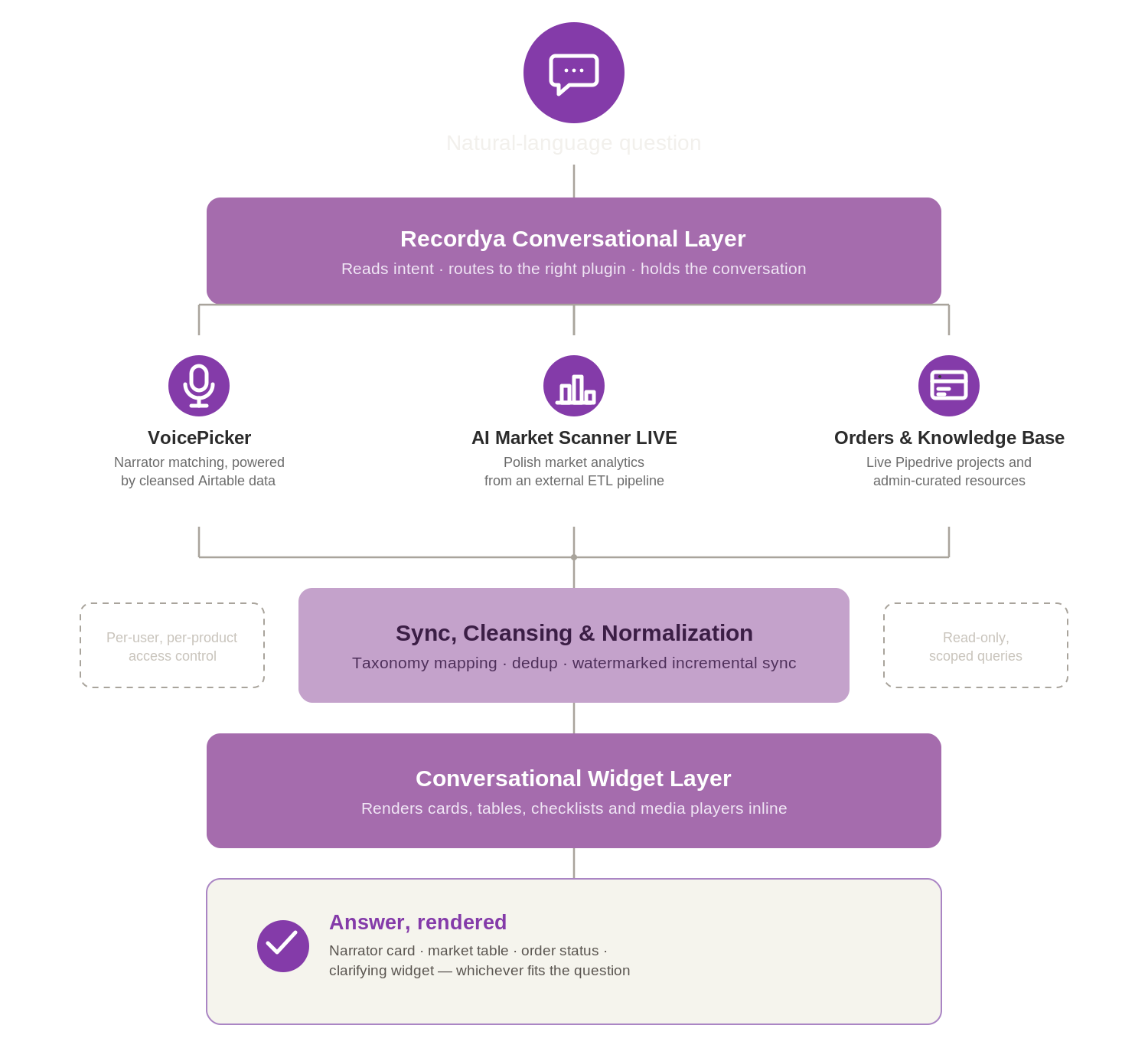
Nexocode built Pick A Voices’s AI capabilities on Recordya, its agentic AI search and plugin engine, which supplies the base application architecture, a plugin mechanism, a chatbot/search layer, and a conversational user interface. Building on Recordya meant each Pick A Voice’s capability could ship as a domain-specific plugin on a common technical foundation, instead of as a separate, independently maintained application.

VoicePicker: AI-Assisted Voice Casting

VoicePicker is an AI assistant that recommends narrators for a given audiobook. A user describes the book — its genre, mood, the narrator’s expected gender or vocal tone, or any other preference — in plain language, and VoicePicker returns the best-matching candidates. The plugin reasons over data about each narrator: genre specialization, vocal character, audiobook experience, expert recommendations, ratings and reach, portfolio, voice demos, and photos, all presented as candidate cards.

Much of the implementation work went into preparing this data so the AI could use it safely. Narrator data is synced from Airtable, which serves as the operational source of truth, and the sync pipeline cleans and normalizes it — standardizing text fields, numbers, ratings, value lists, demo links, photos, and details added by the Pick A Voice’s team. As a result, a user doesn’t need to know the underlying data structure or field names — a request like “a male narrator for a crime novel with a low voice” is enough for VoicePicker to turn that intent into a safe, structured search and return concrete recommendations.

AI Market Scanner LIVE: Real-Time Market Intelligence

AI Market Scanner LIVE is a plugin for analyzing the Polish audiobook market. Users can ask about popular titles, categories, platforms, authors, publishers, and narrators, or about market trends generally. The plugin connects to an external market data source, from which information about audiobooks, rankings, platforms, categories, and market participants is pulled through an ETL process: fetched in batches, transformed, mapped to a common data model, and stored in a structured analytical database.

A significant part of the work was normalizing data coming from different platforms, since category names and the names of authors, publishers, and narrators can vary in format, spelling, or structure from one source to the next. nexocode built a data-cleansing process that maps platform-specific categories to a shared taxonomy, standardizes author, publisher, and narrator names, deduplicates records, unifies platforms and rankings, and syncs incrementally with watermarks so reprocessing the same data doesn’t create duplicates or drift. With that foundation in place, AI Market Scanner LIVE can answer questions like “which genres dominate on Storytel?”, “compare Audioteka and BookBeat”, or “which narrators appear most often in the rankings” without anyone opening a spreadsheet.

Orders View: Live Project Status from Pipedrive

The Orders view lets Pick A Voice’s’s users track the projects tied to their organization, with data pulled directly from Pipedrive, so nothing has to be re-entered by hand. It groups projects by organization, automatically finds or creates the right Pipedrive filter for each organization, pulls current project data through the Pipedrive API, maps Pipedrive-specific fields such as project phase, assigned narrators, and links, and refreshes automatically via webhooks when something changes in the CRM. Publishers get a single place to check the status of their projects, while Pipedrive stays the system of record for Pick A Voice’s’s sales and operations team.

Knowledge Base: A Shared Resource Library

The Knowledge Base is a lightweight library of links and materials available to all Pick A Voice’s users. An administrator can add, edit, or remove entries, and logged-in users can browse what’s been published — instructions, process documentation, onboarding material, resource links, or other reference content — without engineering needing to be involved in every update.

Access Management, Without Engineering Involvement

Pick A Voice’s’s administrators can grant, extend, or revoke a user’s access to individual products — VoicePicker and AI Market Scanner LIVE — directly from the application, without touching the database. Access is managed per user and per product: an admin can set an expiration date, extend access by a given number of days, or revoke it by setting it to expire. If a user was created outside the standard Pipedrive-driven flow, the application can create a technical profile for them so their access can still be managed the same way. This cuts down on manual admin work and lets Pick A Voice’s turn on access to a feature quickly when a customer needs it.

A Conversational Interface That Talks Back in Widgets

Recordya’s chatbot/search layer means Pick A Voice’s’s users interact with all of these tools through one conversational interface, not several separate ones. The AI reads the user’s intent, works only against a defined, safe set of read operations, and uses domain-specific prompts to keep responses short, business-focused, and understandable to non-technical users. When a question is ambiguous, the interface can generate a clarifying widget — a set of clickable options — instead of a back-and-forth in plain text.

When there’s an answer, results are rendered as whichever UI component fits them best: narrator cards, tables, lists, action elements, or media players for voice demos. In VoicePicker, that means candidate cards with a narrator’s key details, recommendations, photo, portfolio link, and a way to play their demo; in AI Market Scanner LIVE, it means tables and structured summaries alongside a short written interpretation. VoicePicker’s language handling also accounts for Polish-specific grammar, such as the adjective inflections used to describe vocal tone. This behavior is covered by evaluation test sets.

Impact

The project delivered working AI plugins and operational views that now support Pick A Voice’s’s day-to-day work:

Case Study Schema AI-Powered Voice Casting and Market Intelligence for Audiobook Publishers

Tools

React

React

GPT-5.2

GPT-5.2

Recordya

Recordya

Python

Python

Have a similar project in mind?

LET'S TALK!

Challenges

Data Quality Across Sources
Narrator data from Airtable and market data from external sources arrived in inconsistent shapes and needed real cleaning before an AI system could use it reliably — standardizing fields, deduplicating records, and reconciling naming and category differences across platforms.

Keeping the AI Inside Safe Boundaries
The model had to be constrained to a defined scope and protected against technical probing, prompt injection, and attempts to extract sensitive data, all while still handling open-ended natural-language questions from users.

Business Language, Not Technical Output
Answers needed to read like something a publisher would say to a colleague, not a database query result — clear, short, and framed around a business decision rather than the underlying data model.

Wiring AI Responses to the Right Widget
Getting a chatbot response to trigger the correct Recordya widget — a clarifying question, a card layout, a table, a media player — so a user could either refine their query or see results in a useful form, required close coordination between the conversational layer and the interface.

Staying in Sync with External Systems
VoicePicker and AI Market Scanner LIVE both depend on data staying current. The Airtable sync needed to update existing records without breaking links to related user data, and the market-data ETL needed to run on a schedule and tolerate being re-run over the same data without producing duplicates or drift.

Making Pipedrive the Source of Truth Without Manual Syncing
The Orders view had to reflect Pipedrive accurately at all times — matching projects to the right organization filters and reacting to CRM changes via webhooks — without any manual re-entry of sales or project data.

Domain Adaptation for Audiobooks
The AI needed a working understanding of the audiobook market itself — genres, narrator roles, platforms, and the vocabulary Pick A Voice’s's own team uses day to day — including Polish-language nuances specific to describing voice and tone.

testimonial author photo

Marcin Gontarz
Chief Executive Officer at Pick a Voice

Nexocode team implemented the recordya.ai multi-agent system, customized to meet our specific business needs. The project included extensive customization of the user interface, ensuring that the solution matched our internal processes and the expectations of our users. We would especially like to highlight the way Nexocode managed the project. Throughout the cooperation, the team maintained excellent communication, worked transparently, and showed a high level of commitment.

Our other projects:

Maas Loop

Building a Real-Time Packaging Recognition System Designed for Edge

A fraud-resistant recognition system built for Maas Loop's deposit return machines, from dataset to deployment

Computer Vision Data Engineering Edge AI

Recordya

Building an Agentic AI Search Platform for Enterprise Knowledge Work

From a search box to a reasoning engine — how nexocode designed and built Recordya, an enterprise agentic AI search platform that goes beyond retrieval to deliver answers.

Generative AI Agentic AI Data Engineering

Time4Travel

AI-Powered CRM for Group Travel Reservations

Transforming group travel management with AI and intuitive design

AI Data Engineering LLMs Generative AI

See more projects

This site uses cookies for analytical purposes.

Accept Privacy Policy

In the interests of your safety and to implement the principle of lawful, reliable and transparent processing of your personal data when using our services, we developed this document called the Privacy Policy. This document regulates the processing and protection of Users’ personal data in connection with their use of the Website and has been prepared by Nexocode.

To ensure the protection of Users' personal data, Nexocode applies appropriate organizational and technical solutions to prevent privacy breaches. Nexocode implements measures to ensure security at the level which ensures compliance with applicable Polish and European laws such as:

  1. Regulation (EU) 2016/679 of the European Parliament and of the Council of 27 April 2016 on the protection of natural persons with regard to the processing of personal data and on the free movement of such data, and repealing Directive 95/46/EC (General Data Protection Regulation) (published in the Official Journal of the European Union L 119, p 1); Act of 10 May 2018 on personal data protection (published in the Journal of Laws of 2018, item 1000);
  2. Act of 18 July 2002 on providing services by electronic means;
  3. Telecommunications Law of 16 July 2004.

The Website is secured by the SSL protocol, which provides secure data transmission on the Internet.

1. Definitions

  1. User – a person that uses the Website, i.e. a natural person with full legal capacity, a legal person, or an organizational unit which is not a legal person to which specific provisions grant legal capacity.
  2. Nexocode – NEXOCODE sp. z o.o. with its registered office in Kraków, ul. Wadowicka 7, 30-347 Kraków, entered into the Register of Entrepreneurs of the National Court Register kept by the District Court for Kraków-Śródmieście in Kraków, 11th Commercial Department of the National Court Register, under the KRS number: 0000686992, NIP: 6762533324.
  3. Website – website run by Nexocode, at the URL: nexocode.com whose content is available to authorized persons.
  4. Cookies – small files saved by the server on the User's computer, which the server can read when when the website is accessed from the computer.
  5. SSL protocol – a special standard for transmitting data on the Internet which unlike ordinary methods of data transmission encrypts data transmission.
  6. System log – the information that the User's computer transmits to the server which may contain various data (e.g. the user’s IP number), allowing to determine the approximate location where the connection came from.
  7. IP address – individual number which is usually assigned to every computer connected to the Internet. The IP number can be permanently associated with the computer (static) or assigned to a given connection (dynamic).
  8. GDPR – Regulation 2016/679 of the European Parliament and of the Council of 27 April 2016 on the protection of individuals regarding the processing of personal data and onthe free transmission of such data, repealing Directive 95/46 / EC (General Data Protection Regulation).
  9. Personal data – information about an identified or identifiable natural person ("data subject"). An identifiable natural person is a person who can be directly or indirectly identified, in particular on the basis of identifiers such as name, identification number, location data, online identifiers or one or more specific factors determining the physical, physiological, genetic, mental, economic, cultural or social identity of a natural person.
  10. Processing – any operations performed on personal data, such as collecting, recording, storing, developing, modifying, sharing, and deleting, especially when performed in IT systems.

2. Cookies

The Website is secured by the SSL protocol, which provides secure data transmission on the Internet. The Website, in accordance with art. 173 of the Telecommunications Act of 16 July 2004 of the Republic of Poland, uses Cookies, i.e. data, in particular text files, stored on the User's end device.
Cookies are used to:

  1. improve user experience and facilitate navigation on the site;
  2. help to identify returning Users who access the website using the device on which Cookies were saved;
  3. creating statistics which help to understand how the Users use websites, which allows to improve their structure and content;
  4. adjusting the content of the Website pages to specific User’s preferences and optimizing the websites website experience to the each User's individual needs.

Cookies usually contain the name of the website from which they originate, their storage time on the end device and a unique number. On our Website, we use the following types of Cookies:

  • "Session" – cookie files stored on the User's end device until the Uses logs out, leaves the website or turns off the web browser;
  • "Persistent" – cookie files stored on the User's end device for the time specified in the Cookie file parameters or until they are deleted by the User;
  • "Performance" – cookies used specifically for gathering data on how visitors use a website to measure the performance of a website;
  • "Strictly necessary" – essential for browsing the website and using its features, such as accessing secure areas of the site;
  • "Functional" – cookies enabling remembering the settings selected by the User and personalizing the User interface;
  • "First-party" – cookies stored by the Website;
  • "Third-party" – cookies derived from a website other than the Website;
  • "Facebook cookies" – You should read Facebook cookies policy: www.facebook.com
  • "Other Google cookies" – Refer to Google cookie policy: google.com

3. How System Logs work on the Website

User's activity on the Website, including the User’s Personal Data, is recorded in System Logs. The information collected in the Logs is processed primarily for purposes related to the provision of services, i.e. for the purposes of:

  • analytics – to improve the quality of services provided by us as part of the Website and adapt its functionalities to the needs of the Users. The legal basis for processing in this case is the legitimate interest of Nexocode consisting in analyzing Users' activities and their preferences;
  • fraud detection, identification and countering threats to stability and correct operation of the Website.

4. Cookie mechanism on the Website

Our site uses basic cookies that facilitate the use of its resources. Cookies contain useful information and are stored on the User's computer – our server can read them when connecting to this computer again. Most web browsers allow cookies to be stored on the User's end device by default. Each User can change their Cookie settings in the web browser settings menu: Google ChromeOpen the menu (click the three-dot icon in the upper right corner), Settings > Advanced. In the "Privacy and security" section, click the Content Settings button. In the "Cookies and site date" section you can change the following Cookie settings:

  • Deleting cookies,
  • Blocking cookies by default,
  • Default permission for cookies,
  • Saving Cookies and website data by default and clearing them when the browser is closed,
  • Specifying exceptions for Cookies for specific websites or domains

Internet Explorer 6.0 and 7.0
From the browser menu (upper right corner): Tools > Internet Options > Privacy, click the Sites button. Use the slider to set the desired level, confirm the change with the OK button.

Mozilla Firefox
browser menu: Tools > Options > Privacy and security. Activate the “Custom” field. From there, you can check a relevant field to decide whether or not to accept cookies.

Opera
Open the browser’s settings menu: Go to the Advanced section > Site Settings > Cookies and site data. From there, adjust the setting: Allow sites to save and read cookie data

Safari
In the Safari drop-down menu, select Preferences and click the Security icon.From there, select the desired security level in the "Accept cookies" area.

Disabling Cookies in your browser does not deprive you of access to the resources of the Website. Web browsers, by default, allow storing Cookies on the User's end device. Website Users can freely adjust cookie settings. The web browser allows you to delete cookies. It is also possible to automatically block cookies. Detailed information on this subject is provided in the help or documentation of the specific web browser used by the User. The User can decide not to receive Cookies by changing browser settings. However, disabling Cookies necessary for authentication, security or remembering User preferences may impact user experience, or even make the Website unusable.

5. Additional information

External links may be placed on the Website enabling Users to directly reach other website. Also, while using the Website, cookies may also be placed on the User’s device from other entities, in particular from third parties such as Google, in order to enable the use the functionalities of the Website integrated with these third parties. Each of such providers sets out the rules for the use of cookies in their privacy policy, so for security reasons we recommend that you read the privacy policy document before using these pages. We reserve the right to change this privacy policy at any time by publishing an updated version on our Website. After making the change, the privacy policy will be published on the page with a new date. For more information on the conditions of providing services, in particular the rules of using the Website, contracting, as well as the conditions of accessing content and using the Website, please refer to the the Website’s Terms and Conditions.

Nexocode Team